%20(1).jpg)


The restaurant growth landscape is changing fast.
Over the past 18 months, three shifts have started reshaping how customers discover restaurants, how venues capture revenue and how strong customer relationships are built.
The pattern is becoming clear.
The venues growing most effectively are not simply working harder. They are using information more intelligently, owning more of the customer relationship and paying closer attention to which channels actually drive profitable growth.
Here are three shifts restaurant operators should be watching.
1. AI search is changing restaurant discovery
Restaurant discovery no longer starts and ends with a page of search results.
In February 2025, just over 10% of restaurant search queries triggered AI-generated results. By February 2026, that figure had reached 78%.
That matters because AI search does more than point customers toward websites.
It can recommend specific venues, explain why they are worth visiting and, in some cases, provide a direct path to booking.
Over the same period:
- 45% of consumers now use AI to find local venues
- 12 months earlier, that figure was 6%
- 83% of restaurants do not appear in the AI answer at all
- When AI recommends a venue, visitors convert at nine times the rate of a regular Google search visitor
For restaurant brands, the implication is significant.
Discovery is increasingly happening inside the answer itself.
The question is no longer only whether your venues rank in traditional search. It is whether AI understands your brand well enough to recommend it when a customer asks where to eat.
2. Missed calls are still leaking revenue
While restaurant discovery becomes more sophisticated, one of hospitality's oldest channels continues to create a very simple problem.
The phone rings.
Nobody answers.
Across the venue network, the industry average shows 40% of restaurant phone calls go unanswered.
Every missed call can represent:
- a booking that never gets made
- a catering enquiry that goes to another venue
- a takeaway order that disappears
- a regular customer who gives up and moves on
The estimated cost sits at $30.80 in lost revenue per missed call.
At 10 to 20 missed calls every day, the annual revenue gap can quickly reach six figures.
The problem is that missed calls are almost invisible.
They do not appear as cancelled orders. They do not show up as lost bookings in the end-of-night report.
They simply disappear.
Some venues using Otto are capturing phone-order revenue that would otherwise leave the business. In some cases, that reaches around $500 per day, per venue.
During a single peak dinner hour, some venues can also receive more than 30 calls. A traditional phone line has a hard limit on how much of that demand staff can realistically manage alongside service.
AI changes that equation.
3. Diners are becoming more selective
Australians now dine out 12% less frequently than they did before 2020.
At the same time, average spend per head has increased by 8% to 15%.
Customers have not stopped eating out.
They are choosing more carefully.
Instead of spreading visits across a large number of restaurants, diners increasingly build a smaller group of favourites and return to the venues that consistently feel worth their time and money.
One in three diners changed a favourite restaurant in the last year, not because food quality declined, but because another venue made them feel more recognised.
That changes the restaurant growth equation.
Acquisition still matters.
But retention matters more.
Restaurants need to give customers a reason to choose them again — and have a way to continue that relationship after the order, booking or visit is complete.
Platform consolidation is changing customer ownership
At the same time, the platforms surrounding hospitality are consolidating.
DoorDash acquires SevenRooms and Deliveroo.
Uber moves on Delivery Hero.
American Express owns Resy and Tock and continues building its presence across the hospitality customer journey.
The direction is clear.
Large platforms increasingly want to participate across discovery, booking, ordering, payments and loyalty.
That does not make platforms the enemy.
They solve real problems. They create reach. And they can introduce restaurants to customers they may not otherwise reach.
But there is an important difference between using a platform as a tool and depending on a platform for the customer relationship.
Strong restaurant brands build relationships inside their own ecosystem, under their own brand.
That gives them more resilience when commissions change, algorithms shift, discounting increases or platforms consolidate.
The more of the relationship a restaurant owns, the more control it retains over future growth.
Three decisions strong operators are already making
Better performance does not always come from a bigger footprint, a larger marketing budget or a better location.
Often, it comes from a handful of operational decisions that compound over time.
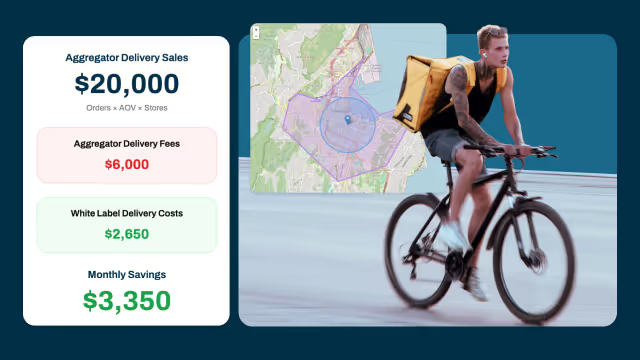
Decision 1: Move more delivery from aggregator to direct
One pizza franchise shifted delivery volume away from an aggregator and into its own direct ordering channel.
The result:
- nearly $250,000 a year saved in aggregator fees
- an 18% increase in the size of its customer database
There was no major new campaign.
No additional hire.
The business changed the channel.
And that channel change did two things at once.
It improved economics while also giving the restaurant a direct customer relationship.
Instead of simply knowing that an order happened, the brand knows who ordered, can communicate with that customer again and can build future repeat business on its own terms.
That is the difference between processing an order and building an asset.
Decision 2: Answer every call with AI
A venue in regional New South Wales introduced Otto to handle incoming calls.
Instead of relying on staff to answer the phone while managing service, Otto can respond around the clock, answer common questions and take orders.
One recent month showed:
- 27 calls through Otto
- 16 confirmed orders per day
- an average order value of $31
- around $500 in phone-order revenue captured each day
There is also an operational benefit.
If someone calls in sick, the phone still gets answered.
If five customers call at once during Friday dinner service, the system can respond to them simultaneously.
A traditional phone line cannot.
That means less demand lost to voicemail, busy signals or the restaurant down the road.
Decision 3: Communicate consistently, not randomly
Discounting does not equal loyalty.
It rents loyalty.
A Sydney pizzeria sends one SMS campaign every week.
The message is not random. Each campaign has a purpose: promote a product, create demand on a quieter day or build urgency around a limited-time offer.
The consistency matters.
Customers begin to recognise the communication. They know what to expect. And they have a clear reason to act.
The restaurant itself has not fundamentally changed.
The relationship has.
That is where first-party customer data becomes valuable.
A database is not useful simply because it contains thousands of email addresses or phone numbers.
Its value comes from what a restaurant does with it.
Strong venues measure more than volume
Hospitality has always been attracted to visible signs of success.
A full dining room.
A queue out the door.
A Saturday night with record order volume.
But volume can create a dangerous illusion.
A packed restaurant does not automatically mean a profitable restaurant.
High delivery volume does not mean every channel is contributing equally.
And a large number of customers does not mean the restaurant has a way to bring those customers back.
Strong operators measure different things.
They ask:
- How profitable is each ordering channel?
- How many customers can we communicate with directly?
- How much revenue comes from customers deliberately choosing our brand?
- Which channels create repeat behaviour?
- Where are commissions and discounts quietly eroding margin?
Those questions change decisions.
And better decisions compound.
Margin pressure makes channel economics harder to ignore
Restaurant margins are already under pressure.
Wages rise 4.75% in Australia from July 1.
Penalty rates, overtime, leave loading and new payday super timing create additional pressure.
Food costs continue to rise.
At the same time, consumers are becoming more selective.
Restaurant operators are being squeezed from both ends.
On one side, customers have been trained by aggregators to expect offers such as:
- free delivery
- 20% off
- buy one, get one free
On the other, restaurants often absorb the discount and pay commission on top.
There is only so far that model can stretch.
The answer is not simply to sell more orders.
It is to understand which orders are worth having.
That means focusing on channels that remain profitable and building systems that do not depend entirely on platform-driven discount economics.
Three assets restaurants may already have
Many restaurant groups do not need to reinvent their business to find the next growth opportunity.
They already have valuable assets sitting inside the operation.
They simply need to use them better.
1. Customer data
Email addresses, phone numbers and order histories are often already sitting inside restaurant systems.
That information creates a direct marketing channel.
It allows brands to understand customers, communicate with them and encourage repeat behaviour without paying a third party every time they want to reconnect.
2. Commission-free revenue opportunities
Catering, private events and off-peak experiences can often generate incremental revenue without relying on high-commission channels.
They may also produce stronger margins than traditional delivery volume.
The opportunity is not always finding a new customer.
Sometimes it is giving an existing customer another reason to spend.
3. Technology already being paid for
Many restaurant businesses use only a fraction of what their technology stack can actually do.
Features sit unused.
Customer data sits untouched.
Automations never get switched on.
The next efficiency gain may not require another platform.
It may come from getting more value from the systems already in place.
A five-minute channel profitability check
A useful starting point is surprisingly simple.
Choose your highest-volume ordering platform and pull up last month's figures.
Find these five numbers:
- Total orders
- Average order value
- Discounts given
- Platform fees paid
- Food cost
Then calculate the estimated profit per order.
The result can be revealing.
Headline order volume rarely tells the full story. Platform fees, discounts and food costs all sit underneath that number.
Once you have the result, repeat the calculation for another channel.
Then compare your aggregator economics with your direct ordering economics.
That comparison will often tell you more than total order volume ever could.
Three questions every restaurant operator should ask
There are three simple questions worth answering now:
- Does your restaurant appear when customers use AI to decide where to eat?
- How many calls did your venues miss last week?
- Of your last 100 customers, how many could you contact directly today?
If the answer is unclear across all three, there is your starting point.
The bottom line
The restaurant market is not going back to the way it worked five years ago.
AI search will continue changing discovery.
Unanswered calls will continue costing restaurants revenue.
Customers will continue becoming more selective.
And platforms will continue competing for a larger share of the hospitality customer journey.
The restaurant brands in the strongest position will be the ones that respond deliberately.
They will:
- own more of the customer relationship
- make better use of first-party data
- reduce unnecessary revenue leakage
- understand the profitability of every channel
- use technology to make their teams more effective
Growth in 2026 is not simply about generating more demand.
It is about capturing more of the demand you already have — and keeping more of the customer relationship when you do.




.avif)



.avif)
.avif)

.avif)

%203.avif)




%203.avif)
%203.avif)